Staying Human: AI, the Future of Work and Christian Discernment
May 29, 2026
•Speeches

Together for the Common Good invited Longbeard CEO Matthew Harvey Sanders to give a keynote on AI and the future of work at the London Jesuit Centre on 20 May 2026. The following day, he was invited to the House of Lords for a discussion hosted by Lord Griffiths of Fforestfach with peers and MPs to continue the conversation.
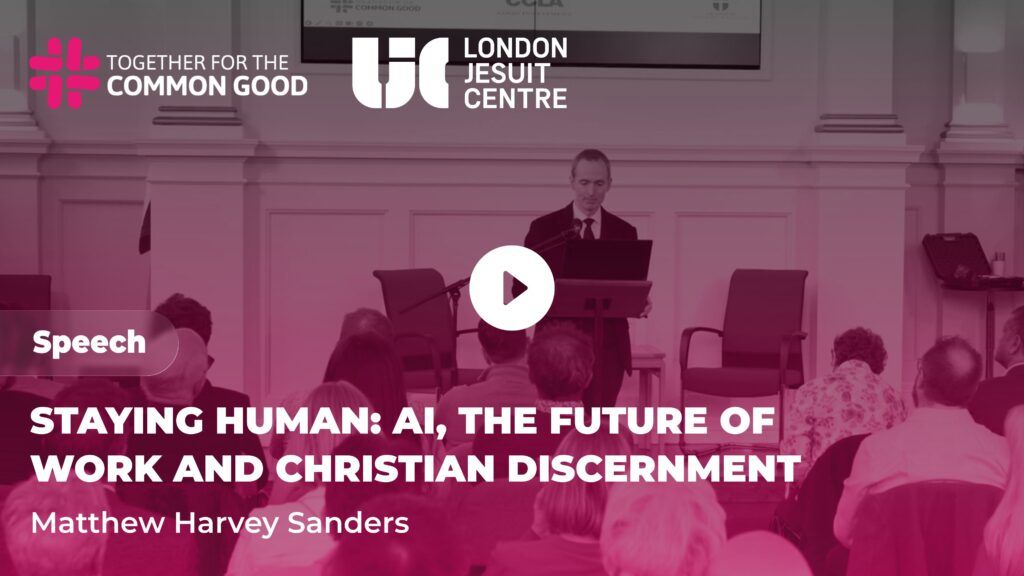
At the great turning points of this civilization, questions about work, about what it does to human beings and what human beings owe one another through it, have found their way to rooms like this one. Not usually before the disruption has arrived, but inside it, when the cost has become impossible to look away from. I think we are at that point now. I find myself grateful for that, and for the invitation to think it through with you.
I want to note the date. We’re five days past the one hundred and thirty-fifth anniversary of Rerum Novarum, Leo XIII’s letter of the fifteenth of May, 1891. That encyclical gave the modern Church her language for work, her framework for thinking about what labour does to human beings and what human beings owe one another through it. It is the right moment to be asking these questions again.
There’s also a river about a mile east of here that has its own quiet connection to the anniversary we’re marking. I’ll come back to it before the evening is out.
I should say at the outset that I run a company that puts artificial intelligence into the hands of users every day, and I see, at quite close range, what these systems can and cannot yet do, and what they’re about to be able to do. I don’t say that to claim authority I haven’t earned in front of a room with rather more theological and pastoral experience than I have. But I do think it means some of what I’m about to say will be harder to dismiss as alarmism, and I suspect some of it will be rather harder to hear.
Here, then, is the question I’d like us to sit with for the next forty-odd minutes. We are about to find out whether the things that make human work worth doing, and, just as importantly, the things that work has been doing to human beings for as long as there have been human beings, can survive what is coming. I’m not sure the world has asked that question carefully enough. Tonight, with your help, I want to try.
I want to move from the evidence, what is actually happening and on what timeline, to the theological instrument I think is the right one for diagnosing it. From there, to what it means for this country, which is rather more exposed than the headlines suggest. And from there to what I think is being asked of the traditions gathered here: a framework for discernment, a vision of what might come after, and three specific charges to this room.
Let me begin with where we actually are, because I think the honest answer is that most of the public conversation is still describing a future that has, in fact, already arrived.
The Stanford AI Index for 2026 reports that generative AI reached fifty-three per cent population adoption in three years. The smartphone took six years to reach that threshold. This took three. Nothing has moved faster. Eighty-eight per cent of organisations are now using AI in some form. Four in five students, from high school to university, now use generative AI for their schoolwork. The question is no longer whether this has arrived. It has. The question is what it is becoming.
On capability: agent task success, the ability of these systems to carry out multi-step work autonomously, rose from twelve per cent to sixty-six per cent in a single year on key benchmarks, according to Stanford’s AI Index. The UK government’s own assessment of AI capabilities, published last year, found that frontier models now produce what evaluators judge to be expert-quality work on nearly half of real-world professional tasks, and that the complexity of tasks these systems can perform autonomously has roughly doubled every seven months. I’d ask you to hold that doubling figure in mind. It’s the rate, more than any single capability, that should concentrate the attention.
The productivity numbers are equally striking. Gains of fourteen to twenty-six per cent in customer support and software development, large by historical standards. But there is one finding in the Stanford data that I want to park for a moment and come back to later, because it turns out to matter more than anything else on the page. The report notes that productivity gains are, and I quote, “weaker or negative in tasks requiring more judgment.” Hold that finding lightly in the back of your mind. It will return.
Now, there’s a gap I find it impossible to read without some pastoral concern. Seventy-three per cent of AI experts expect a positive job impact from this technology. Twenty-three per cent of the public do. That is a fifty-point chasm between the people building the systems and the people who will live inside the world those systems make. I’d suggest, at the risk of being too direct, that a fifty-point gap of that kind is a political and pastoral emergency waiting to happen. The question isn’t whether the gap closes. It’s how, and how violently, and who is there when it does.
One quick theological proviso, because I know this room will want it. I’m not making any claim tonight about machine consciousness, or moral agency, or interiority. I think those questions are real and the answer is clearer than some of the marketing suggests. But none of tonight depends on it. Economic disruption only requires capability. And the capability is here.
Let me turn now to what I think the timeline actually looks like, with the caveat that I hold these projections loosely, as anyone honest about this technology should. The builders themselves disagree, sometimes sharply, and I’d want you to weigh the testimony rather than take any single voice as gospel. But I think it’s useful to think of the disruption arriving in three waves.
Before I describe those waves, I want to name one thing clearly, because it is easy to miss in the current conversation. What we are discussing tonight is not only a software phenomenon. The same intelligence that is replacing the analyst and the junior lawyer is, as it becomes embodied in physical systems: in the humanoid robots now being deployed in warehouses and on factory floors by companies like Figure and Tesla, beginning to move into manual and physical work as well. The timeline is different: software deploys faster because there are no physical constraints. But the direction is the same. There is no sector, ultimately, that the combination of software AI and embodied AI leaves untouched. White-collar work is simply first.
Now, the first horizon is roughly the next two years, by 2028. This is the entry-level white-collar wave, and it is already happening. In the United States, employment among software developers aged twenty-two to twenty-five fell by nearly twenty per cent between 2024 and last year. In the UK, job adverts for high-exposure occupations dropped thirty-eight per cent between 2022 and 2025. One-third of organisations surveyed expect to reduce their workforce in the coming year. Mustafa Suleyman, who is CEO of Microsoft AI and is, I’d point out, a builder not a critic, said earlier this year that most white-collar work will, in his words, be “fully automated by an AI within the next twelve to eighteen months.” Dario Amodei, the chief executive of Anthropic, told Axios in May 2025 that AI could wipe out, in his words, “half of all entry-level white-collar jobs within five years.” These are not external critics warning about a hypothetical. These are the people shipping the product, describing the consequences of what they themselves are shipping.
The second horizon is roughly five years out, but I want to pause here, because five years out now means arriving in the same window as what may be the most consequential event in this entire story: AGI. Artificial General Intelligence: a system capable of performing most cognitive tasks that human beings can do. Demis Hassabis, the CEO of Google DeepMind, said at Davos in January this year that he assigns a fifty per cent probability to AGI arriving by 2030. Sam Altman, CEO of OpenAI, in February, said we may be only a couple of years from early versions of true superintelligence. If that is roughly right, and I hold it loosely as I think anyone honest about this technology should, then the picture changes fundamentally. We would not be living, by the middle of this decade, in a world of AI augmentation. We would be living in the first years after a threshold that no previous economic disruption has reached.
Think carefully about what AGI arriving by 2030 means for the employment picture. Even now, before AGI, practitioners already describe a consistent pattern: one person, equipped with current AI tools, doing the work of five. Within a year of AGI arriving, in an economy that will, by then, have spent a decade deploying and integrating AI systems throughout every sector, the more honest figure may be one person doing the work of a hundred. Or two hundred. I want to be careful here: I am not certain of the number, and neither is anyone else. But I am fairly certain of the direction. And I would suggest that a society that has not begun to reckon with that possibility now, in pastoral care, in formation and in civic imagination, will find itself reckoning with it in conditions of considerably greater urgency.
Think about what that means for work. Not just white-collar work: mid-career professionals, analysts, writers, lawyers, accountants. Blue-collar work too: logistics, manufacturing, construction and maintenance, as AI moves from software into embodied systems. Humanoid robots are no longer a laboratory curiosity. They are on factory floors now, doing the repetitive physical tasks that have employed working-class people in this country for two centuries. The pace of deployment in that domain is behind software AI, but the trajectory is the same. The pattern being described today, one person equipped with AI tools doing the work of five, will look modest by comparison. Dylan Patel, the founder of SemiAnalysis and one of the most rigorous infrastructure analysts in the field, offered perhaps the most clinically honest version of this employment logic in a podcast interview this past April. ‘If this person can do the work of five to 10 to 15 people using these tools,’ he said, ‘then all of a sudden I should probably cut people.’ I find that phrase worth sitting with for a moment, not because it is callous, but because it names the structural logic with a kind of dispassionate clarity that more optimistic visions of augmentation tend to set aside. Vinod Khosla, the Silicon Valley venture capitalist and co-founder of Sun Microsystems, expects AI to handle eighty per cent of economically valuable work within five years. Sam Altman put it more starkly: “By the end of 2028, more of the world’s intellectual capacity could reside inside of data centers than outside of them.” And then, almost as a throwaway: “It’ll be very hard to outwork a GPU.” Andrew Bailey, the Governor of the Bank of England, and I’d note this is not a man given to rhetorical excess, has said publicly that AI-driven job displacement could rival the Industrial Revolution. I’d suggest, gently, that even that comparison may be too modest. Demis Hassabis, CEO of Google DeepMind, told The Guardian last August that AI will be ten times bigger than the Industrial Revolution and perhaps ten times faster, unfolding over a decade rather than a century. If that is right, then Bailey’s benchmark is not alarmist. It is conservative. The comparison to the Industrial Revolution is apt. It may simply be the wrong end of the scale.
The third horizon is roughly ten years out, by 2036, and here I’d ask for your patience, because we’re moving into territory the builders themselves describe as genuinely uncertain. This is the post-work horizon. Amodei, again, said on CNBC at the end of January this year that AI is not replacing a single job, but is becoming, in his phrase, “a general labour substitute for humans.” A general labour substitute. Let that phrase sit for a moment. And then there is Elon Musk, and you can take Mr Musk however you take him, but he said this in November 2023, on a stage in London, alongside the then Prime Minister Rishi Sunak. He said: “There will come a point where no job is needed. You can have a job if you want to have a job, for personal satisfaction, but the AI will be able to do everything.”
I want to balance that with the most thoughtful voice in the field, which I think is Demis Hassabis. In an interview with TIME magazine earlier this year, he was asked what happens after AGI arrives. His answer is worth hearing in full: “Then I think it’s a question of: can we distribute the productivity gains fairly and widely around the world? And then there’s still a question after that, of meaning and purpose. So that’s the next philosophical question, which I actually think we need some great new philosophers to be thinking about today.” I find that remarkable. The man building the most powerful AI system on earth is calling for philosophers. He has the engineering. He does not have the anthropology.
Before I move on: a word on why this will not slow down. The United States cannot pause, because a pause advantages China. China cannot pause either: with an ageing population and a manufacturing economy under growing pressure, it needs AI and robotics more urgently than almost any other major power. Both sides understand that the first to reach AGI will very likely be the first to reach ASI, Artificial Superintelligence: a system that exceeds human cognitive capacity across every domain. The country that crosses that threshold first will hold economic and military advantages that are difficult to overstate. That is why slowing down, whether for job market stability or AI safety, is a concession neither side believes it can make unilaterally. The consequence for every other nation follows from this: those without sovereign AI capacity will find themselves dependent on Washington or Beijing for infrastructure that underpins their economies, their energy, and their defence. This race is structural. It will not wait. Which means the Church cannot wait for policy to catch up. The disruption will not pause at the door of the parish.
Those three horizons, two years, five years and ten years, raise a question that the language of productivity and labour economics, for all its real usefulness, can’t quite reach. The builders can see, with remarkable clarity, what is ending. What they don’t have, and what I think the Christian tradition does have and has had for some time, is a category for what is actually being lost. And, as it happens, I think a forty-five-year-old papal text gives us exactly the right one.
I want to pause here, before the data gives way to theology, and name what I think is actually happening. The disruption I’ve described is not primarily an economic event. It is an anthropological one. It is a question about what human beings are for, when the economic rationale for their labour has been removed or diminished. That is not a question productivity economics was built to answer. It is a question that Catholic social thought has been working on for a very long time.
I want to turn now to John Paul II’s encyclical Laborem Exercens, published in 1981. And I want to introduce it not in the spirit of “and now for the religious portion of the evening,” but in a rather different spirit: this is a text that turns out, to my surprise as many others, to be a remarkably precise instrument of diagnosis for exactly the moment we’re in.
The core move John Paul makes in section six of that letter is to distinguish two dimensions of human work. There is, first, what he calls the objective dimension: what is produced. The brief that gets written. The contract that gets drafted. The diagnosis that gets reached. The code that gets shipped. The bridge that gets built. The objective dimension is what economists measure. It’s real and important and I don’t want to be heard as minimising it.
But there is, second, what he calls the subjective dimension: what happens in the worker through the doing of the work. Character formed. Judgment trained over years of getting it slightly wrong and learning from the wrongness. Vocation discerned. Conscience sharpened against real cases. Relationships built between colleagues, between mentor and apprentice, between professional and the person served. The image of God shaped, slowly, through the discipline of making something and being responsible for it. The subjective dimension is what work does to the worker.
And John Paul’s claim, the one I want us to take seriously tonight, is that the subjective dimension is, in his words, the more important of the two. The famous formulation in section six is this: “Work is ‘for man’ and not man ‘for work.'”
I’d suggest the question this raises for us is not whether machines can do our work. In many domains they already can, and they will increasingly. The real question is what we lose, what the worker loses, when the scaffolding of that formation is removed. What happens to a generation that never has the apprenticeship? Never gets the slightly humiliating moment of being corrected by a senior at four in the afternoon? Never builds the judgment that only comes from being responsible for an outcome you couldn’t quite produce on your own?
I’d note, too, that this isn’t a conclusion I’m reaching on my own. In January last year, the Dicastery for the Doctrine of the Faith published a note called Antiqua et Nova, addressing artificial intelligence directly. And when the Dicastery reached for an instrument with which to think about AI, the instrument it reached for was Laborem Exercens, section six. The note observes that AI “performs tasks” but does not “think.” It draws the line, clearly and explicitly, that “only humans are moral agents.” This isn’t retrospective application. This is the doctrinal office of the Catholic Church saying: the category we need for this moment was given to us forty-five years ago.
Leo XIV, speaking to the Pontifical Academy for Life last November on AI and medicine, put the same point in pastoral language. He said: “Medical professionalism can never be reduced merely to solving a problem.” Think about what he’s doing there. The objective dimension of the doctor’s work, reaching the right diagnosis, is something an AI system can already do, in many cases, as well as or better than the average clinician. But the doctor’s work, Leo is saying, is not the diagnosis. It is the relationship with the suffering person. An AI can produce the diagnosis. It cannot be the doctor.
And now I want to return to a finding I mentioned earlier: that I asked you to hold in mind. The Stanford report observed that AI productivity gains are weaker or negative in tasks requiring more judgment. I’d suggest, very gently, that this is not a coincidence. The market is discovering, by trial and error and quarterly earnings calls, the same boundary that the theology identified four and a half decades ago. The machine runs up against the subjective dimension and slows. The economists don’t yet have a name for what the wall is made of. We do.
I’ll close this section with Newman, who put the same intuition in his own register, in the Idea of a University, Discourse 8. He wrote: “The world is content with setting right the surface of things; the Church aims at regenerating the very depths of the heart.” I think that’s almost exactly right for the moment we’re in. AI is going to set right the surface of an enormous amount. The Church tends the depth. The two are not in competition. But only one of them is irreplaceable.
If that distinction holds, if the objective and subjective dimensions really are distinct and if it really is the subjective dimension that the machine can’t reach, then it gives us something rather useful. A working instrument of discernment. I want to suggest, tentatively, four marks of what must remain human, each grounded not only in theology but in sources that I think this room will find credible on their own terms.
The first mark is judgment under moral weight. Decisions in which a human life, or human dignity, or a human future is at stake. The sentence handed down. The diagnosis delivered. The hire made or the redundancy issued. The decision to operate when the outcome is uncertain. Think of the partner at the law firm who must decide whether to take a case that will pay the bills but trouble her conscience. The AI can map the precedents. It cannot carry the weight. Antiqua et Nova is clear: only humans are moral agents. Leo XIV, in his message for the sixtieth World Communications Day, published in January this year, put the risk plainly: ‘renouncing creativity and surrendering our mental capacities and imagination to machines,’ he wrote, ‘would mean burying the talents we have.’ And, perhaps most strikingly, the economics agrees. The Stanford finding, again: weaker or negative gains in tasks requiring judgment. Three independent witnesses, the magisterium, the Pope, and the productivity data, pointing to the same boundary. I’d suggest we ought to take that convergence seriously.
The second mark is presence with the suffering. This is Leo XIV’s point about medicine, and it generalises. The chaplain at the bedside. The nurse who notices that something is wrong before the monitors do. The social worker. The priest in the confessional. The teacher who stays after class because the child is hesitating at the door. These are not jobs in the GDP sense. They are, I’d suggest, a form of being with another person, a way of being present that is itself the substance of the work, not the wrapping around it. Presence can be imitated. It cannot be replicated. And I would gently suggest that the widespread deployment of AI in pastoral care, without this distinction being very clearly in view, would be a pastoral emergency, not a pastoral innovation. You’ll know better than I where the pressure points in your own traditions are. But I suspect they’re closer than we’d like.
The third mark is the formation of conscience and character. Catechesis. Mentorship. Spiritual direction. Parenting. Teaching the young to discern between things that look alike but are not the same. Think of the young person learning, slowly and through failure, to tell the truth when the truth is costly. This is the work of building the subjective dimension in another person, of shaping a soul over years rather than delivering an output in seconds. This is, I’d suggest, the Church’s home ground. It is also, I’d note with some sadness, precisely the ground that the economy of the last two generations has spent considerable energy teaching us to undervalue. The catechist and the contract lawyer have not been compensated according to their relative contribution to human flourishing.
The fourth mark is the givenness of community. Friendship. Marriage. Parish. Neighbourhood. The body of Christ in its irreducibly local form. Relationships that are received rather than optimised. Think of the neighbour you did not choose, whose need arrives at your door unbidden, and whom you help anyway because you are formed in a tradition that tells you that is what neighbours are for. The market has no instrument for measuring these things. That is not a criticism of markets: markets are not designed to price friendship or parish or the loyalty of a neighbourhood. But it does mean that when the market alone organises social life, these goods tend to go unprotected and unreplaced. The Church, when she is being herself, holds them as gifts. As the medium, in fact, through which the human person finds grounding.
I’d put the pastoral implication of these four marks like this, and I offer it knowing that you, not I, will have to work it out in practice. Every formation programme, every seminary curriculum, every lay leadership pipeline in this country ought now to be asking itself a fairly direct question. Are you forming people for these four things? Or are you still, by inheritance and habit, training them for objective tasks that the machines will do better than they do next year, and better still the year after that? Because if it’s the latter, the pipeline is, with respect, training people for a world that is already vanishing.
Given this framework, then, given what is genuinely at stake in those four marks, I want to try to make it specific. Not to the abstract global economy, which is rather too easy a thing to gesture at. But to this country. To this city. To the congregations many of you lead.
Because this isn’t an American conversation being imported. Britain, I’d suggest, is structurally more exposed than the headlines have so far made clear. The Department for Science, Innovation and Technology’s own assessment, published last year, found that seventy per cent of UK workers are in occupations that AI could perform or substantially enhance, against a US average of sixty per cent. Roughly a third of the UK workforce sit in what the assessment calls “low complementarity” roles, roles where AI doesn’t augment the worker, it displaces them. And, as I mentioned earlier, job adverts in high-exposure occupations dropped thirty-eight per cent between 2022 and last year. These are not projections. They are descriptions of what has already begun.
Why is Britain more exposed? I’d suggest the answer is uncomfortably simple. Britain made a national bet, over the last forty years, on services. Finance. Law. Consulting. Professional services. Administration. Media. Higher education. These are exactly the sectors that agentic AI processes first and most thoroughly. Germany makes things. Britain processes information. That comparative advantage has, rather suddenly, become a comparative vulnerability. And I’d note, without wanting to make this too geographic, that London and the South East carry a disproportionate share of that vulnerability. The map of British prosperity over the last generation and the map of British exposure to AI displacement are, I’m afraid, very nearly the same map.
I want to add one voice to that picture from outside Britain, because it names what the numbers mean when filtered through someone with no incentive to be alarmed. Ken Griffin, the founder of Citadel, manages approximately sixty-five billion dollars and has, for much of the last two years, been among the more hard-nosed sceptics of artificial intelligence in global finance. At the World Economic Forum in January of this year, he called generative AI, in his own words, garbage. That was four months ago.
Earlier this month, at Stanford, he said something rather different. He described agentic AI systems inside Citadel completing work that would previously have required teams with master’s degrees and PhDs in finance, work measured in weeks or months, in a matter of hours or days. He was quite precise about what he was describing: “These are not mid-tier white-collar jobs. These are extraordinarily high-skilled jobs being automated by agentic AI.” And then he said he went home one Friday “fairly depressed”, because when you witness it in your own institution, when the data points stop being projections and become something happening in the room next door, the impact becomes difficult to look away from.
I raise him not to end on that note. Griffin is a brilliant diagnostician of markets and, I suspect, a rather more limited diagnostician of what markets exist to serve, but because a man of that temperament, describing that experience, in a speech released a fortnight before this one, seems to me like exactly the kind of witness this conversation deserves.
Now, connect that data to the four marks we’ve just walked through, and I think the question that emerges is deeper than it first appears. The roles being displaced fastest are not the manual trades. They are the junior professional roles: the trainee solicitor, the graduate analyst, the junior developer, the assistant editor, the first-year associate. These are the apprenticeships through which judgment, presence, conscience, and community have historically been formed. Perhaps by 2035, with AGI reshaping the economy, even those senior roles will themselves be automated. Perhaps they will be. But I don’t think that settles the question. It deepens it. Because what we are dismantling is not a career pipeline. It is a formation pipeline. The way human beings learn to sit with complexity. The way they develop the judgment to act when the answer is not clear. We are dismantling the conditions under which human judgment is formed, at the very moment when human judgment is the one thing an AI cannot supply.
Andrew Bailey’s comparison to the Industrial Revolution, coming from the Governor of the Bank of England and not from a pulpit, is worth dwelling on for a moment. The Industrial Revolution did, eventually, produce extraordinary wealth. It also produced, along the way, the dock workers of 1889. It produced the conditions that Rerum Novarum was written into. I think it is worth being honest about who the dock workers of 2035 are likely to be: what kind of work they’ll do, or fail to find, and what kind of churches and chapels and communities will, or won’t, be there to meet them.
The data tells us what is being lost. What it cannot tell us, what no productivity report however careful will ever tell us, is what waits on the other side. We have spent some time now with the diagnosis. I want to give what time remains to the question of response: what I think is being asked of the traditions gathered here, and whether the Church has something to offer that no productivity strategy can furnish. I find myself thinking she might, and I’d like to try to say why.
The horizon we’re approaching, and I think we are approaching it though I hold the timing loosely, is one in which the link between human work and human survival, a link that has held for the entire span of recorded history, is severed. That’s worth sitting with for a moment. For as long as there have been human beings, the question “how will you eat?” has been answered, for most people, by some version of “I will work.” That equation is what economists, theologians, and politicians have been arguing about for two centuries. And it may be, within the working lives of people sitting in this room, that the equation simply dissolves.
I want to be careful here. I’m not suggesting the end of human work. Human beings will go on making, tending, teaching, healing, creating, praying; it is, I think, constitutive of what we are. What I’m suggesting is the end of working primarily to survive. And that is a different civilization.
Elon Musk, speaking at the Viva Technology conference in Paris in May 2024, put it this way: “In a benign scenario, probably none of us will have a job.” He gave that scenario roughly an eighty per cent probability. Now, you can take that estimate seriously or you can take it with a fistful of salt; I’d suggest somewhere in between is wise. But what I find more interesting is the question he asked next, because it’s the right question. “The question will really be one of meaning,” he said. “If a computer can do everything better than you, does your life have meaning?” That is, I would suggest, one of the more theologically serious sentences uttered by a technology executive in our lifetime.
His answer, though, is where I think the argument runs short. His answer is universal high income, work reconceived as, and I quote, “sports or a video game,” and everyone enjoying abundance. And I want to say, as gently as I can, that this is despair dressed as utopia. Work as a video game is not a vision of human flourishing. It’s a vision of human sedation. It mistakes the absence of necessity for the presence of purpose, and those are not the same thing at all.
Let me add a partial counter, because honesty requires it. As the machine economy grows vast and cheap, a parallel human economy may grow alongside it — smaller, premium, valued because a person made it. The Etsy economy, if you like, beside the GDP economy. People will pay more for human craft, human teaching, human care. This is genuine. But it does not scale to a civilisation, and it does not answer the question of meaning.
Viktor Frankl, whose reflections in Man’s Search for Meaning and The Will to Meaning address this directly, and who knew rather more about meaning under conditions of extremity than most of us ever will, observed that when human beings lose the structure and purpose that organised their days, they don’t quietly flourish in their newfound leisure. They become disoriented. They become unwell. The crisis of the post-work era, it seems to me, will not be a crisis of poverty. It will be a crisis of meaning. And a society that has spent two centuries telling people that their worth is measured by their economic contribution will discover, rather suddenly, that it has no other vocabulary available when the economic contribution is no longer required.
Now, this is where I want to bring in Universal Basic Income, because the conversation about UBI has become, in my view, both more urgent and more inadequate than its proponents recognise. UBI is necessary. I’ll say that plainly. If the link between work and survival is severed, some mechanism of distribution has to replace it, and UBI in some form is probably the least bad of the available instruments. But it is necessary and insufficient. It addresses what John Paul II called the objective dimension of work: the wage, the output, the economic transaction. It does nothing whatsoever for the subjective dimension: the formation of the worker, the cultivation of judgment, the experience of being needed, the dignity of contribution. No government programme has ever given a person a vocation. And I would suggest no government programme ever will.
Which is why Leo XIV’s words at a conference on artificial intelligence last December land with such force in this context. He said: “Human beings are called to be co-workers in the work of creation, not merely passive consumers of content generated by artificial technology.” That is the diagnosis in a single sentence. UBI addresses survival. It does not address vocation. It cannot tell a person what they are for.
So what does the Church actually offer here? Not, I hope, a policy paper. Something more fundamental. Structure. Community. Vocation. Shared purpose. Formation in communion. And, this matters, offered not from above, not as imposition, but at the level of the person and the parish.
And here I want to say something about this country in particular. For most of England’s history, life was organised around towns, villages, and parishes. The spire was the centre of the settlement, geographically and otherwise. People knew their neighbours. Obligation was face-to-face. The pub, the school, the parish church, the market: these were not abstractions. They were the texture of life. Now, I’m not romanticising the medieval village. There was poverty, there was cruelty, there was the closed mind of the small community. I’m not asking anyone to recreate it. But I would suggest that the human scale the parish represents is not, in the post-work era, an exercise in nostalgia. It may be the forward-looking answer. Because when survival no longer organises the day, what does? And the honest answer is: nothing organises the day unless something local, embodied, and shared organises the day.
Which brings us to subsidiarity, that lovely Catholic word for what is in fact a deeply ecumenical instinct, that decisions should be made at the most local level capable of making them. Parish. Community. Family. Subsidiarity in the industrial era was a theological nicety. In the post-work era, I would suggest, it becomes a practical necessity. Because the alternative, meaning administered from a great height by states and platforms, is not meaning at all. It’s management. The parish as infrastructure, then: small communities organised around purpose and faith, where people work because they choose to, apply their gifts because they’re called to, and find meaning because they are formed in communion with others who are doing the same.
That, very briefly, is the vision. But that vision is not self-executing. It requires people with authority, with learning, and with civic voice to make deliberate decisions, now, before the displacement arrives at scale. Let me turn now to what I think is actually being asked of us.
Three specific charges to this room.
The first is to the pastors and bishops, and to those who serve under your authority. Begin preparing your people now. The displacement has already begun in entry-level work; I gave the numbers earlier and I won’t repeat them. There are young adults in your congregations who are losing first jobs that aren’t coming back, and they don’t yet know that’s what’s happening. Preach about work as vocation, not merely as employment. Form your people in the subjective dimension, in judgment, in presence, in formation and in community, before those things are needed as substitutes for income. And please, I would urge, treat the parish not as a fading institution to be managed in graceful decline, but as quite possibly the most important community anchor the neighbourhood possesses. Because it is. And it’s about to matter more, not less.
The second charge is to the Christian thinkers, the academics, the writers in this room. Let me read you a sentence from Leo XIII, from Rerum Novarum, 1891: “a small number of very rich men have been able to lay upon the teeming masses of the labouring poor a yoke little better than that of slavery itself.” He wrote that in response to the disruption of his era. I would suggest the sentence requires almost no updating. A small number of very rich men now control the systems that will reshape the labour of every person in this country. We have Rerum Novarum for the industrial worker. We have Laborem Exercens for the late-industrial worker. We do not yet have the document for the post-work worker. Leo XIV is, I think, the right man to write it, but he cannot write it alone. He needs theologians who understand transformer architectures. He needs economists who haven’t quietly conceded the question to Silicon Valley. He needs ethicists willing to think past the next product cycle. The encyclical that will matter in 2035 is being thought now, in rooms like this one, or it isn’t being thought at all.
The third charge is to every Christian in this room, whatever your tradition. Find the young person in your life, the godchild, the nephew, the recent graduate sitting in your pew, and take their situation seriously. Don’t offer false comfort about retraining schemes. Offer them the Church’s conviction that their dignity does not depend on their economic function.
Become informed, and insist that others around you are too. I mentioned earlier that seventy-three per cent of AI experts expect a broadly positive outcome from this technology, while only twenty-three per cent of the public does. That fifty-point gap is not a communications failure. I would suggest it is a democratic emergency. Patel gave a strikingly direct geography of this fracture on the Dwarkesh podcast in March. ‘In San Francisco,’ he said, ‘we’re just thinking on a timescale of weeks. And then if you’re outside of San Francisco, you’re not thinking about AGI at all.’ The people designing this transition are thinking in weeks. The people who will live inside its consequences are, in the main, not thinking about it at all. That asymmetry is not a matter of messaging; it is a structural one, and I think it raises a fundamentally political question. Pope Francis put it precisely in Laudate Deum: “In whose hands does all this power lie, or will it eventually end up? It is extremely risky for a small part of humanity to have it.” The dockers of 1889 did not need a degree in shipping logistics to know whether a fair day’s wage was being paid. The people affected by this transition do not need to be AI researchers to ask: who controls this, who benefits, and who bears the cost? The regulatory frameworks being written now will govern your children’s working lives. An informed laity, exercising civic judgment in the ballot box, in the town hall, in the public square, is not a secondary feature of Christian life. It is one of the Church’s answers to the question of power. Act across confessional lines. Anglican, Catholic, Methodist, Reformed, Orthodox, free church: on this question, we are already one body, because the people losing their work do not sort themselves by communion. The labour movement of the 1880s was built across confessional lines in this city. What’s coming will require nothing less.
Those are the charges. Let me, in closing, try to say why I think this room, this particular room on this particular evening, matters.
I mentioned at the start that there was a river a mile east of here with its own connection to the anniversary we’re marking tonight. It’s the Thames. And in the summer and autumn of 1889, along its docks, a hundred and thirty thousand men struck work in what was then the richest city the world had ever seen. They were asking for sixpence an hour, the Dockers’ Tanner, and a minimum four-hour engagement. Not a revolution. A wage you could feed a child on.
Into that dispute walked Cardinal Henry Edward Manning, Archbishop of Westminster, eighty-one years old. He brought no economic plan. He had no leverage over the dock companies. He commanded no technology, no press operation, no political party. What he carried was moral authority and his willingness to be physically present where the suffering was. He mediated the settlement on the 14th of September.
Ben Tillett, who led the strike, and who was not, I think it’s fair to say, naturally disposed to defer to archbishops, said this afterwards: “I could not withstand this gentle old man, who touched so tenderly the heart-strings of his hearers with solemn talk about the sufferings of wives and children. There was a final judgment, and the Cardinal won.”
And Manning himself had said: “It is not a private affair; it is a public evil. The capitalist is invulnerable in his wealth. The working man without bread has no choice but either to agree or to hunger in his hungry home.”
Two years later, in 1891, Leo XIII published Rerum Novarum. Historians have asserted that Manning’s intervention on the Thames helped move him to write it. Which means, and I want you to sit with this for a moment, the document whose 135th anniversary brings us together tonight was shaped, in part, by what happened a mile from this room. I don’t think that’s coincidence. I think it’s continuity.
I’ve been informed that Lord Glasman, who spoke in this series, has described Manning in three words: stubborn, organised and faithful. I find myself returning to those words. Stubborn: not as obstinacy, but as the refusal to concede under the steady, polite pressure that says the suffering isn’t really that bad, or isn’t really your concern. Organised: because moral conviction without institutional form, it seems to me, tends to evaporate within a generation; somebody has to build the thing that carries it forward. And faithful: because only fidelity, I think, gets you through the long temptation either to despair or to escape into the comforting fantasy that someone else will sort this out.
From Manning on the docks, to Leo XIII in Rome, to Rerum Novarum, to this lecture tonight, to Parliament tomorrow afternoon; I don’t think that line is accidental. And I don’t think it’s finished. It runs through every person sitting in this room.
So I’d simply ask you, in whatever form your own life and vocation make possible: go where the suffering is. Be, perhaps, a little stubborn. A little organised. And, God willing, faithful.
Thank you.


