Introducing the Saints Database
May 12, 2026
•Product Updates

Magisterium AI now includes a structured, contextual database of over 12,000 canonized, beatified, venerable, and martyrs spanning the Catholic Church’s history, giving Magisterium AI unparalleled factual grounding and contextual insight.
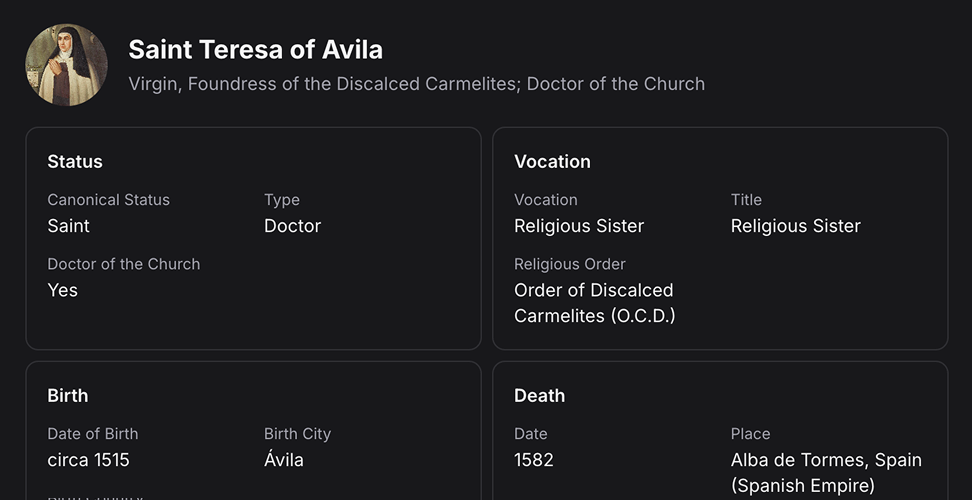
A structured, contextual knowledge base
Until now, information about the saints has been scattered across hagiographies, martyrologies, liturgical calendars, and devotional resources — rarely in one place, rarely queryable, and rarely connected to the broader doctrinal and historical context in which a saint lived.
The Saints Database changes that. Every entry is structured and contextual, meaning you can ask questions about a saint the way you would ask a question of a knowledgeable guide and receive an answer grounded in the tradition, not assembled from the statistical average of the internet.
What you can do with it
The Saints Database is available directly through Magisterium AI. Some of what it makes possible:
Look up any saint by name, feast day, or region.
Whether you’re preparing a homily, teaching a class, or simply curious about the patron of your diocese, the database gives you immediate access to the full record.
Explore the saints in context.
Each entry connects to the broader Magisterium AI knowledge base, so a question about a saint’s theological writings, their canonization process, or their relationship to a particular council can draw on the full depth of the source library.
Query across the database.
Ask who the martyrs of a particular century were, or which saints were associated with a specific religious order. The database supports natural language queries across the entire collection.
Why it matters
The saints are not incidental to the Catholic faith. They are its lived proof. A knowledge base that can reason reliably about Catholic doctrine, history, and moral theology is incomplete without them.
The Saints Database gives Magisterium AI the factual grounding to answer questions about the communion of saints with the same precision it brings to questions of doctrine and scripture.
The Saints Database is available to all Magisterium AI users. Open Magisterium AI and ask about any saint to get started.