Magisterium AI in Theological Inquiry and Religious Education
Oct 31, 2025
•Scholarly Writing

Fr. Kenny Ang, Research Professor in Dogmatic Theology at the Pontifical University of the Holy Cross in Rome, published a paper in Scientia et Fides in October 2025 titled:
“Magisterium AI in Theological Inquiry and Religious Education: Challenges and Emerging Horizons.”
The full text of the paper can be found here. Additionally, a video of Fr. Ang’s pre-print presentation at a May 5, 2025 event hosted by Longbeard at the Pontifical Gregorian University can be found below.
Situated within the framework of the Church’s ethical teachings on technology, Fr. Ang offers a critical evaluation of Magisterium AI, arguing that its development requires not only a sophisticated “hierarchy of sources” to manage its database but also features that engage with Christian culture and art to ensure the system truly serves human formation rather than merely retrieving data.
Of particular note are two areas of exploration.
Stress Testing
Fr. Ang compares Magisterium AI to several other generative AI platforms, using complex and detailed prompts to measure the extent to which various platforms could engage with nuanced topics.
Magisterium AI demonstrated a robust capacity for generating nuanced and well-considered responses that successfully navigated complex theological tensions. The system excelled at reconciling apparent contradictions, such as harmonizing Pope Francis’s remarks on interreligious dialogue with traditional documents like Dominus Iesus and contextualizing Aquinas’s views on the death penalty within the framework of doctrinal development, exhibiting greater structure and comprehensiveness than other platforms.
Furthermore, when addressing historical canonical anomalies regarding ordination by abbots, Magisterium AI provided a historically accurate and chemically sound explanation consistent with traditional theology, avoiding the categorical and historically unsound errors committed by other AI systems.
Source Library and Document Hierarchy
Fr. Kenny Ang argues that constructing a faithful Catholic AI requires a sophisticated understanding of the “gradations of truth,” rejecting the simplistic view that only formal “magisterial documents” (like encyclicals) are valid sources. He utilizes a schematic framework to illustrate that the Magisterium is not a monolith, but rather a complex hierarchy of authority involving different objects, modalities, and degrees of infallibility.
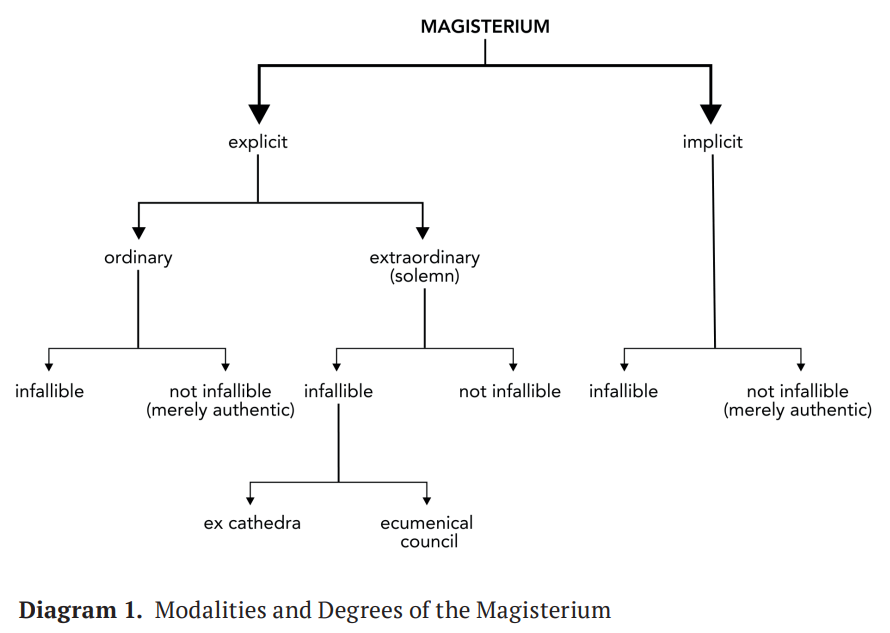
Because the Magisterium does not cover every historical or theological detail, Fr. Ang concludes that the database must stretch beyond the technical bounds of magisterial writing to include theologians, philosophers, and historians. To manage this massive, diverse dataset without creating confusion, he proposes three guiding principles for the AI’s hierarchy:
- Principle of Recency: The AI must prioritize the most current teaching when norms have evolved. For example, it should cite the 1997 Catechism over the Baltimore Catechism, or the 1983 Code of Canon Law over the 1917 Code, ensuring users receive the active norm rather than superseded discipline.
- Principle of Authority: Simultaneously, “older does not necessarily mean less valuable” (269). The AI must be trained to recognize that a giant of theology like St. Thomas Aquinas (13th century) carries more weight in speculative theology than a minor modern author. The system must balance recency with the enduring weight of tradition.
- Principle of Form: This principle addresses the modus significandi, or the way truth is expressed. The AI must discern between the core truth and the culturally conditioned language of the past. Fr. Ang argues that even great saints used expressions that made sense in their time but sound confusing or offensive today.